Service Details
Service Details is where you tune every service you offer: how it maps to your field service software, what it costs, what the AI asks the customer, and how long it takes on site.
What this page controls
For each service you can set its job-type mapping, dispatch fees, qualification & disqualification questions, the desired outcome (Book vs Escalate), and the on-site duration. Open Account → Service Details, then click Edit on a service.
Open Service Details
Go to Account → Service Details to see every service grouped by trade.
→ app.onepath.ai/account/service_details
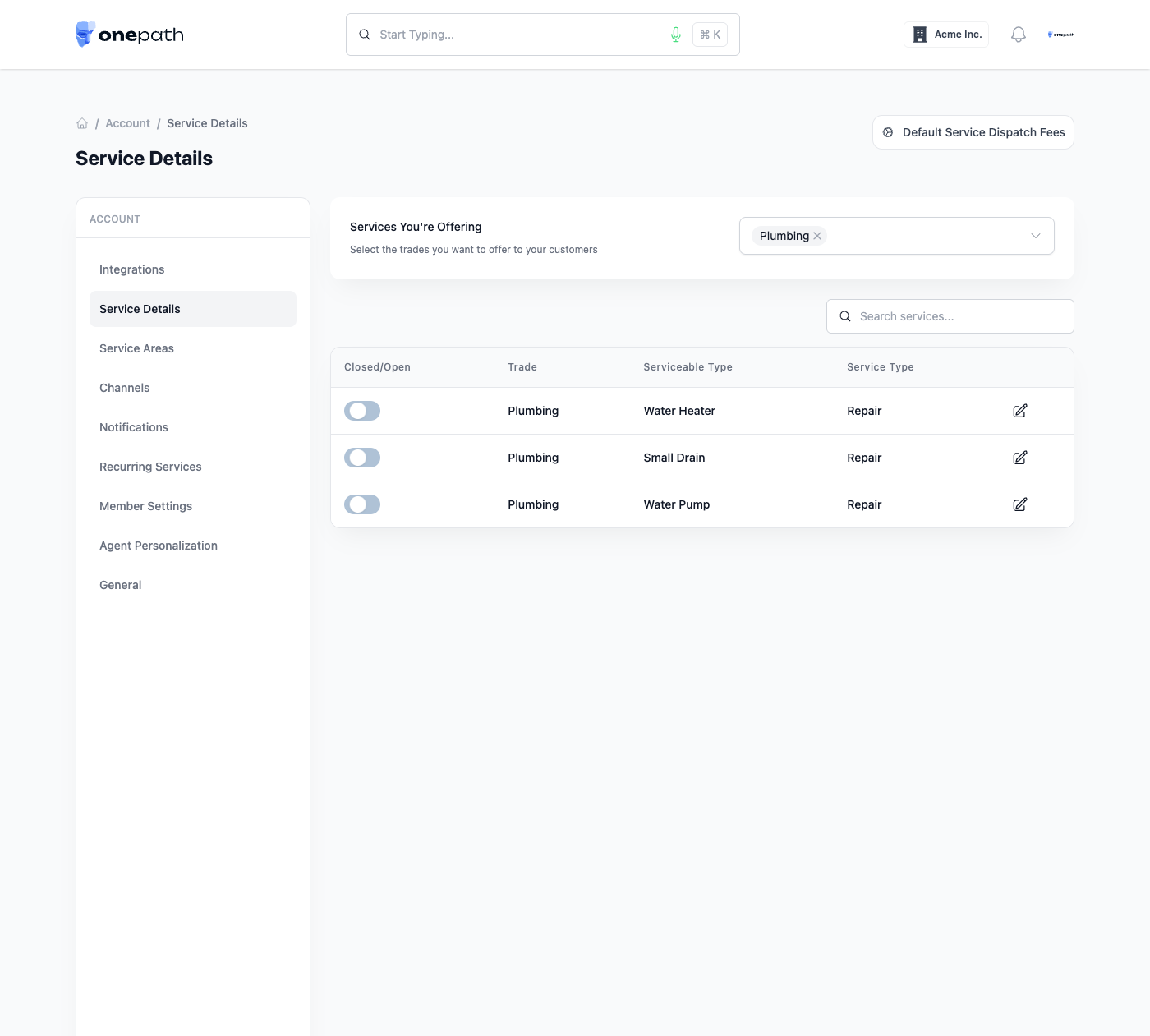
From here you can:
- Pick the trades you offer — the "Services You're Offering" picker at the top controls which trades (and therefore which services) appear.
- Turn a service on or off — the toggle in the Closed/Open column. Turning a service on for the first time creates a default configuration for it.
- Search — filter the list by serviceable type or service type.
- Edit — open a service to configure everything below.
Service Configurations
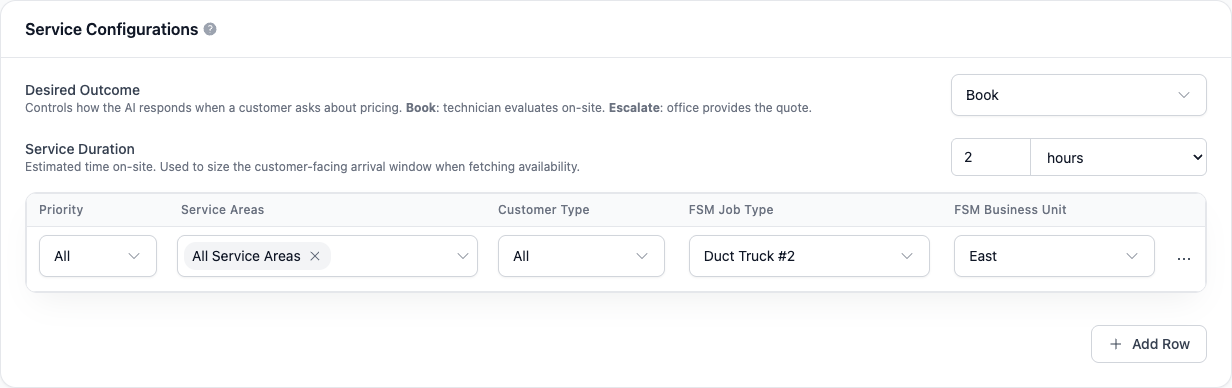
The top card on the edit page holds the service's core settings and its mapping to your field service software.
Desired Outcome
Controls how the AI responds when a customer asks about pricing:
- Book — the technician evaluates the job on-site (the AI moves toward booking an appointment).
- Escalate — your office provides the quote (the AI hands the pricing question off instead of quoting).
Service Duration
The estimated time on-site for this service. It's used to size the customer-facing arrival window when the AI fetches availability — so a 2-hour service offers wider slots than a 30-minute one.
A new service starts from a sensible default that ships with the service template. Change the number and unit (minutes/hours) here to override it for your business.
The mapping table
Each row maps a slice of this service to your field service software. The columns:
- Priority — which urgency this row applies to (e.g. All, or a specific priority).
- Service Areas — which areas this row covers (or All Service Areas).
- Customer Type — All, Residential, or Commercial.
- FSM Job Type — the job type in HousecallPro / ServiceTitan this service books into. This is the mapping.
- FSM Business Unit — (ServiceTitan only) the business unit the job is created under.
Use + Add Row to map different customer types or priorities to different job types — for example, a Residential row pointing at one job type and a Commercial row pointing at another. Every change saves automatically.
Fix a service's job type
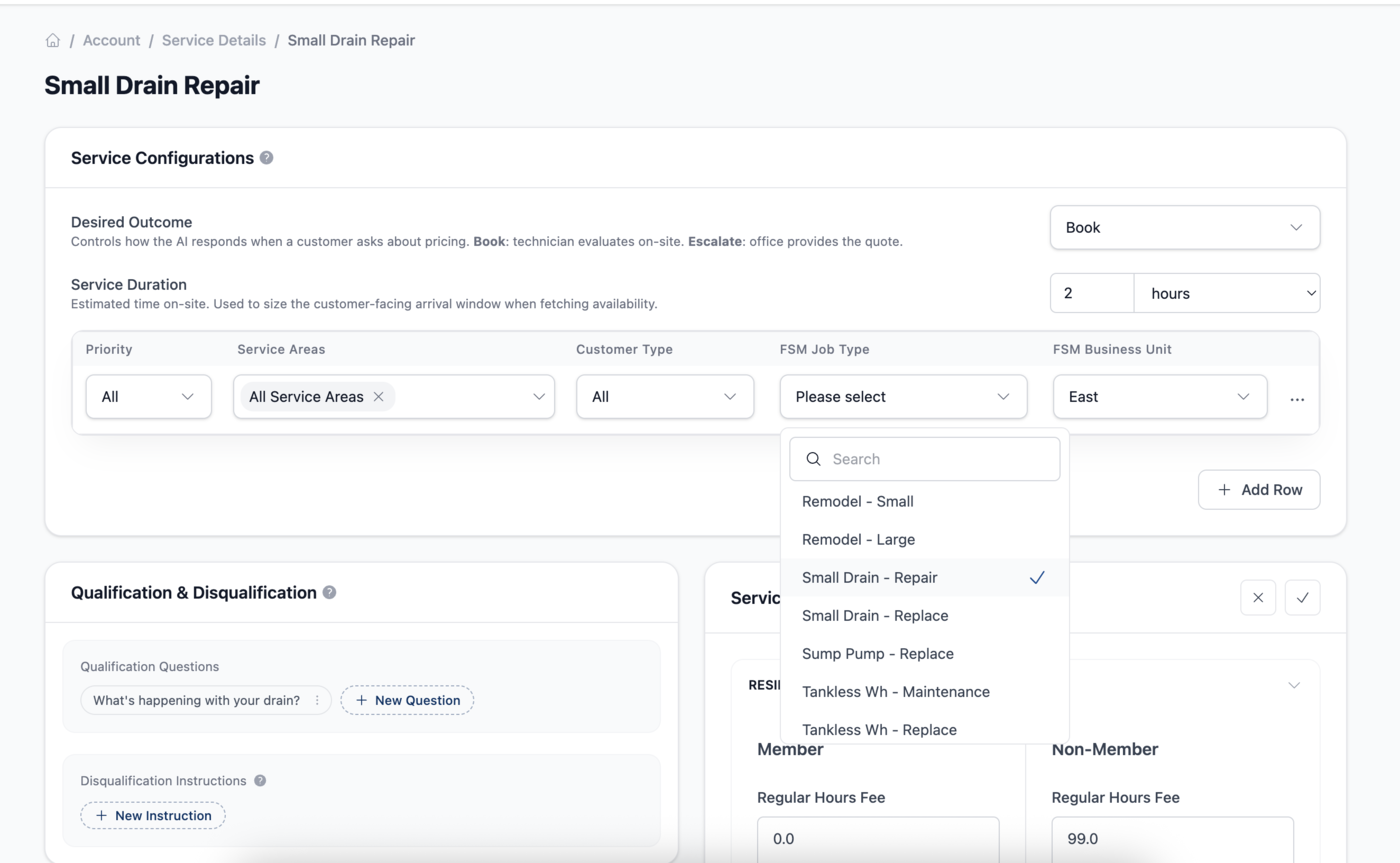
If a job type is deleted or renamed in HousecallPro / ServiceTitan, any row still pointing at it breaks: new appointments fail to sync and never reach your schedule (you may see a "No such job type" error). The fix is to remap the affected rows.
Bookings suddenly failing for a service?
A deleted job type is the usual cause. Open the service, then re-pick a valid job type on every flagged row.
Click the FSM Job Type dropdown on the row. It's searchable — start typing to filter — and only lists job types that currently exist in your field service software. Pick the one that best matches the work.
Multiple rows?
If a service has more than one row (for example separate Residential and Commercial rows), fix the job type on every affected row.
Qualification & Disqualification
This card controls what the AI asks the customer about this service, and when it should walk away.
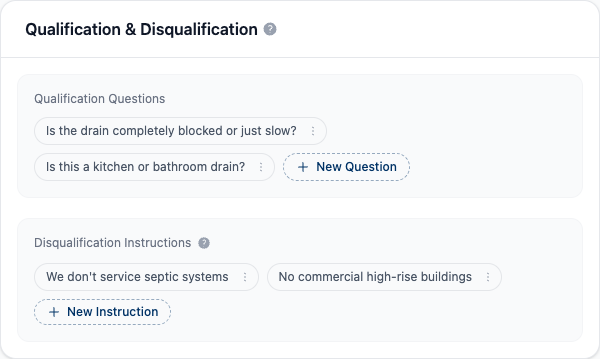
- Qualification Questions — the questions the AI asks to understand the job and pass details on to you. Each service starts from its template's questions, but you can tailor them here. Once you change a question, that service is marked customized so later template updates won't overwrite your edits. Required questions show an
*on their pill. - Disqualification Instructions — your internal criteria for when a lead should not be serviced for this job type (e.g. "We don't service septic systems"). The AI uses these to disqualify out-of-scope leads.
Add or edit a question
Click New Question (or New Instruction for a disqualification rule) to open the inline editor.
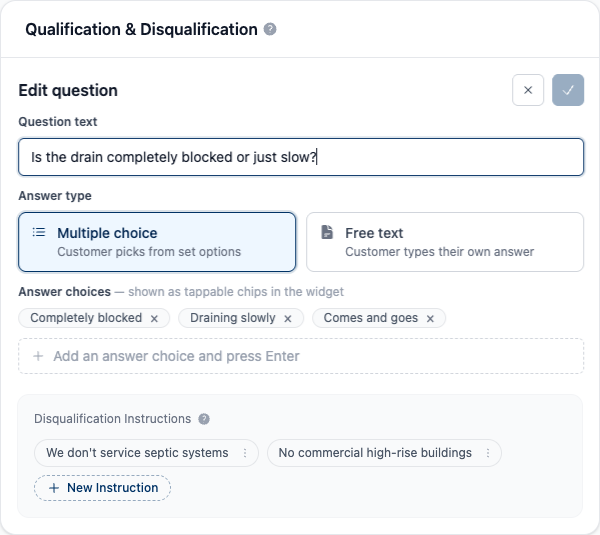
- Type the question text.
- Pick an Answer type:
- Multiple choice — the customer picks from chips you define.
- Free text — the customer types their own answer.
- Photo upload — the customer attaches photos of the problem. The photos travel with the booking: the AI factors what's visible in them into the job summary, and they're attached to the job in your field-management system.
- For multiple choice, add the answer choices. OnePath also suggests choices automatically from your question text when you click out of the text field — accept them or edit your own.
- Use the Required toggle to decide whether the customer must answer before continuing. Photo questions are always optional — they never block a booking.
- Save — the card updates right away.
To change or remove an existing item, open its ⋮ menu:
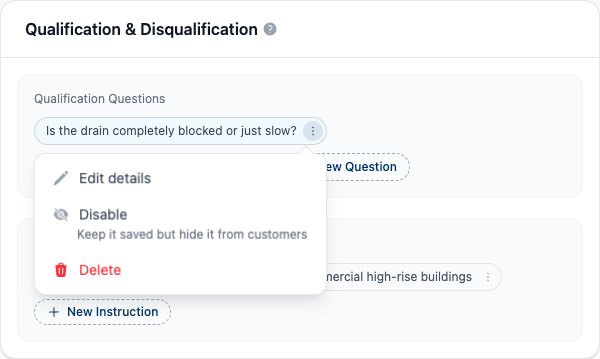
- Edit details — reopen the editor.
- Disable — keep the question saved but stop asking customers (re-enable any time).
- Make optional / Make required — flip whether customers can skip it (not shown for photo questions — those are always optional).
- Delete — remove it for good.
Service Dispatch Fees
Set the dispatch fee the AI quotes for this service. Each fee reads as a plain sentence — tap any fee to edit it and type a price or a note (for example "$135 waived with repairs", "CAD $95", or "tech will discuss"). An empty fee shows Add fee and stays empty.
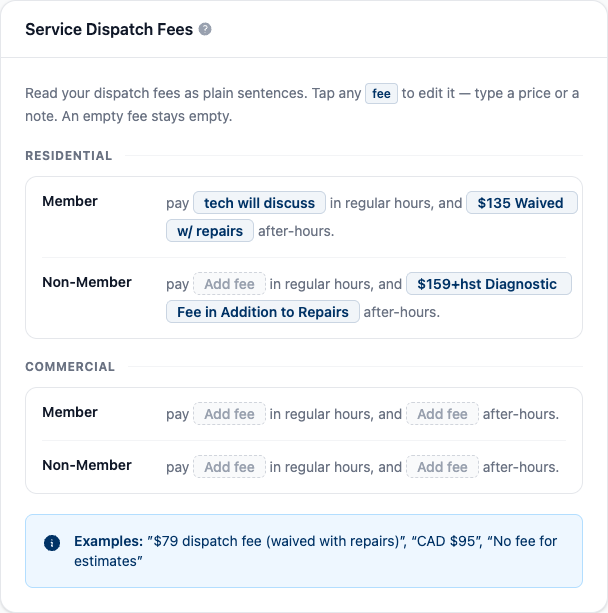
- Grouped by Residential and Commercial, then Member and Non-Member.
- Each row reads: pay [regular-hours fee] in regular hours, and [after-hours fee] after-hours.
- Edits save automatically — there's no separate Save button.
If you don't set fees on a service, it falls back to your account's Default Service Dispatch Fees (the button at the top of the Service Details list), which uses the same editor.
Quick Tips
- ✅ Mapping changes save instantly — there's no separate Save button on the configuration rows.
- ✅ Match the job type to the work — pick the field-service job type that best fits the service.
- ✅ Fix every flagged row — a service can have several configurations; each needs a valid job type.
- ❌ Don't leave a job type blank — a blank mapping fails the same way as a deleted one.
Still stuck?
Reach out in your OnePath Slack channel or email your account manager. Include the service name so we can help fast.